Showing posts with label A to Z challenge. Show all posts

Friday, 12 April 2019

B is for a Picture of a Black Hole

Yes, Katie Bouman, you should be excited. You and the rest of your team who brought us this really cool science image.  A few other people who were involved are Sandra Bustamante, Feryal Ozel, Heino Falcke, and all these people from the Event Horizon Telescope Collaboration. Congrats, guys!

In case you've been living under a rock or off the grid, you will have heard the news of the first image of a black hole. It looks like this:
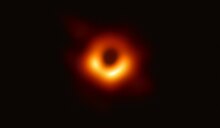
A direct image of the black hole at the core of galaxy Messier 87.
Papers linked at the bottom, for those who wanna go hardcore.

A black hole is a final object (greater than ~2M☉) that has collapsed down due to gravity, because there's no other force (like thermal pressure) to counter the gravity.

Theoretically, we've known about black holes since 1915-ish when Einstein had a few theories about gravity, and Karl Schwarzschild talked about the gravitational fields of mass points. Even the idea behind something so massive that even light cannot escape its gravity has been around since the 18th Century.

Are black holes a real thing? Yes. We know them by their gravitational influence, as well as a few other clues. Here's a couple of recent papers that cover a few things about one of the best-studied black holes, Sagittarius A*, in delightfully nerdish details:


So yeah. Black holes, totally real, and we've known and studied them for at least a hundred years. Thing is, due to their nature, we haven't been able to take a picture of one.

It's hard to take a photo-graph of something that doesn't emit or reflect any photons. So, how did they do it?

In their reportings in the Astrophysical Journal, the team shared, "Einstein's general theory of relativity not only predicts the existence of black holes, but also provides a means to directly observe them. Photons can escape from near the event horizon via an unstable circular orbit, whose observational manifestation would be a bright ring of emission surrounding a dark interior black hole "shadow". The diameter of the shadow for a black hole...as seen by a distant observer is predicted to be...larger than twice the...radius of the event horizon due to light-bending effects...."

This method is only successful if: "(i) there are a sufficient number of emitted photons to illuminate the black hole, (ii) the emission comes from close enough to the black hole to be gravitationally lensed around it, and (iii) the surrounding plasma is sufficiently transparent at the observed wavelength."

And it was. I'm impressed.

(I can't believe I've not devoted an entire blog entry to black holes before! Bad astronomer! No cookie!) If you want to see more science content from  me on my blog, please comment below. I'm happy to oblige. If not, go buy my books and register your opinion that way.

Dr Katie gave a TED talk a couple of years ago about how one would go about imaging a black hole:


Do watch this video. She's so excited and passionate by the science. It's contagious.  I love her line, "I can't show you a picture of a black hole today [in 2017]." 

Well, Katie, you can now:


Papers here for those who want to go hardcore:
Never be afraid to go hardcore on science. Even if your gaze glosses over and your brain turns numb, don't ever let that deter you. Read enough abstracts, and eventually things will begin making more sense. Also, whuffie.

Tuesday, 27 March 2018

No A to Z?

Now I know how Chuck Norris feels.
As You Know, Bob, I've participate in the A to Z Challenge for several years.

However, I'm not doing it this year due to time constraints. Notice how I haven't posted to the blog in yonks? That's because I've been working full time, plus parenting teenagers, plus teaching a morning class, plus my own Astro studies, plus getting three novels ready for publication this year, and Guilder to frame for it. I'm swamped.

While A to Z has been marvelous in the past for drawing in new readers, I simply don't have the time this year to devote.

This is a shame, for several months ago I started sketching ideas. I was going to do Astronomy again, and had come up with some spiffy ideas, some of which I might have lost during the death of a computer. Dunno. Haven't had time to go see what happened to certain minutiae.

Maybe next year. Or maybe at some random, non-April time, when I feel the itch to wax eloquent about the heavens above.

Meanwhile, feel free to ignore my blog until I have the time to be interesting once more.

Or go download the audiobook version of "A Lady of Many Charms and Other Stories".  I hear the narrator did a good job.  Google Play | Audible.au

___________________________
Her Grace doesn't have the time to give a flying foxtrot.

Monday, 8 May 2017

A to Z Challenge Reflection

(Apologies for the long post. I learned a lot.)

I learn new things whenever I do the A to Z challenge. I employed the lessons I learned last time, and it made for a better go-around this year.

What I Learned

  1. Pre-planning. I pre-planned my theme and populated my alphabet. I then did my posts ahead of time (when I could, on my own time) and scheduled them to post on the correct day. This pre-planning really helped A LOT. Most of my posts were done by the end of March.
  2. Audience. I thought about what audience I wanted to cater to, and this helped me focus my posts and have a consistency throughout. I wanted to make my posts interesting to an audience with varying levels of education. I tried to design them so people who didn't know much about astronomy could understand my concepts, yet be intricate enough to push those who had a bit more knowledge about the subject.
  3. Consistency. I wanted a certain level of quality control, so you pretty much knew what you'd get from post to post. Again, I was able to pull this off through pre-planning.

    That said... the topic I chose is completely not relevant to my usual blog. My blog's about writing books generally and Romance specifically. So what topic did I choose?  Astronomy!! The two rarely cross paths (except in a novel of mine that's coming out next year). Why did I choose my topic?
  4. Stand out. I wanted to stand out and offer something unique that the other AtoZers weren't offering. And while there were a few who tackled the same subject, none of them approached it in the same way I did, and that was good. I didn't feel I was duplicating anyone else's efforts. I thought if I blogged about writing,  I'd get lost in the crowd. Probably was right, as there were quite a few writers writing about writing. However, I might go back to that next year and pull a Frain.


A to Z Changes

Part of the A to Z Challenge involves reading others' blogs. This year the Challenge ran a few things differently--no Linky List! This was a boon and a bane.

Boon: No long list of people who'd signed up, then never bothered to blog. You only heard about the people who were being active, and could go straight to their posts.

Bane: Having to post EVERY SINGLE DAY to the AtoZ blog to let people know you had stuff up. I don't get online every day, so this became quite a pain. I wish one could schedule comments the way one schedules blog posts. Since most of my entries were completed ahead of time, it would have been nice not to have to get online every single day to promote my blog. Also, if I came across an interesting blog, and forgot to Favourite it, I'd have to trawl through the blog comments to find it again.

I'd love to see a combination of the old Linky List with the new Blog Comment format. Bring back the Linky List, but you can only get on the Linky List if you've posted an entry. Then, post a weekly Linky List blog post where, if we posted entries that week, we can list them. The pre-registering is probably too much

I was amazed at how many bloggers there were who couldn't figure out how to make a simple anchor tag work, even when shown how.

Also, the absolutely best way to make me scroll past a comment on the A-to-Z daily letter blog post? Posting this:

 . Here is my blog.
 . LINK

Nothing is more boring than that. At the very least post your theme. No, not your name, or even your blog's name, but your theme.  That's what I'm looking for.  Roslyn Core announced how she was cross stitching a Buffy the Vampire Slayer alphabet.  You bet your sweet bippy that got my attention! (No, I'm not a Buffy fan, or a cross stitch fan. But what a juxtaposition!)

What Worked and What Didn't from This Reader's Perspective

What worked for me was a blog that was regular-ish, that had a clearly defined theme or topic, and provided interesting content.

Regular posts is good, because nothing is more disappointing than to come back day after day to find nothing new. That's a good way to lose me.

A clearly defined topic is necessary. It lets me know what to expect on a blog. Now, some topics simply didn't catch my interest because I wasn't their target audience. But the few posts I read were well put together and if I was interested in that, I would have definitely stuck around to read more.

What definitely turned me off were the "personal" or "inspirational" blogs that chronicles someone's inner journey. A lot of people did these, and frankly, I found them very boring. Topics like these are excellent for an audience of one. For the rest of us, "You" are not a sufficiently interesting topic. I'm sorry. Blog entries like "Gratitude" or "Spirituality" only have impact for you.

I noticed there were quite a few story blogs as well, writers posting fiction. Author J R Vicente had a clever "choose your own adventure" style, where the commenters got to choose what the blog post would be for the next day. She gets points for that.

Most of the fiction blogs couldn't hold my attention because the voice wasn't compelling enough. Sometimes I'm not your audience, and sometimes your writing's not as good as you think it is. Fortunately, the more you write, the better you get. I would never tell someone to stop writing simply because they weren't good.

And then there were some story blogs that completely blew me out of the water. John Frain. John Frickin' Manuscript Frain. If you didn't read any of his AtoZ this April, go back and read it. If you've read NOTHING ELSE this month, go back and read John Frain.

Frain wrote a flash fiction story a day, with him as a character that got killed. Every. Single. Time. (or did he?)

I don't think I will forget that one for a long time to come.

Blogs I Enjoyed

It's always fun going through the different blogs and see what others have posted. Some of the more memorable blogs this year were:

I read one blogger, who was rather new to blogging, never mind the A to Z Challenge. No, she didn't post every day, and that was understandable. She wrote about being a single parent to a high-needs child after a bitter divorce. Hers was a deep story about a hard life and I'm glad I got to read it. But can I find it again? No. I want to know how her story ends.

There were a few others I popped in from time to time.  Overall, there were plenty of great blogs to read.

_____________________________
Her Grace will now be crawling back under a rock, as May is a very busy month for her in the Real World.

Monday, 1 May 2017

A to Z - I'm done!


And that's all, folks!

Thanks for coming on a tour of the universe with me. I hope you learned something about astronomy and weren't too overwhelmed by the hardcore science.

The skies above us are a fascinating place, one I've loved for nearly half a century. I encourage you to go out and look up tonight. What can you identify that you couldn't a month ago?  Any new celestial favourites?

While this blog is mostly for me to ramble on about Romance and writing and reviews and my own books (Buy my books!), it's also a place to post about what I love. For the month of April, that was astronomy.

Never be afraid to look beyond the world you know and try something new.


____________________________________
Her Grace shall always love the stars.

Sunday, 30 April 2017

Z is for Zodiac

This isn't about telling your horoscope, but knowing where the Sun is at any particular time of the year. (Those born under the sign of Ophiuchus the Snake-bearer know that Astrology is not a science because nobody has been able to prove its reasoning through the scientific method.)

In Astronomy, there are thirteen constellations that reside along the ecliptic (the path the Sun takes through the sky year-round). This means as the Sun moves through the sky from month to month, it will be found within the boundaries of certain constellations.

Astrologically, the sky is divided into twelve "houses" of 30° each. In astronomy, the constellations of the astronomical zodiac is not so evenly divided, and we've thrown in one more constellation because the Sun does spend some time in one corner of it. The planets and the Moon also move within the ecliptic.

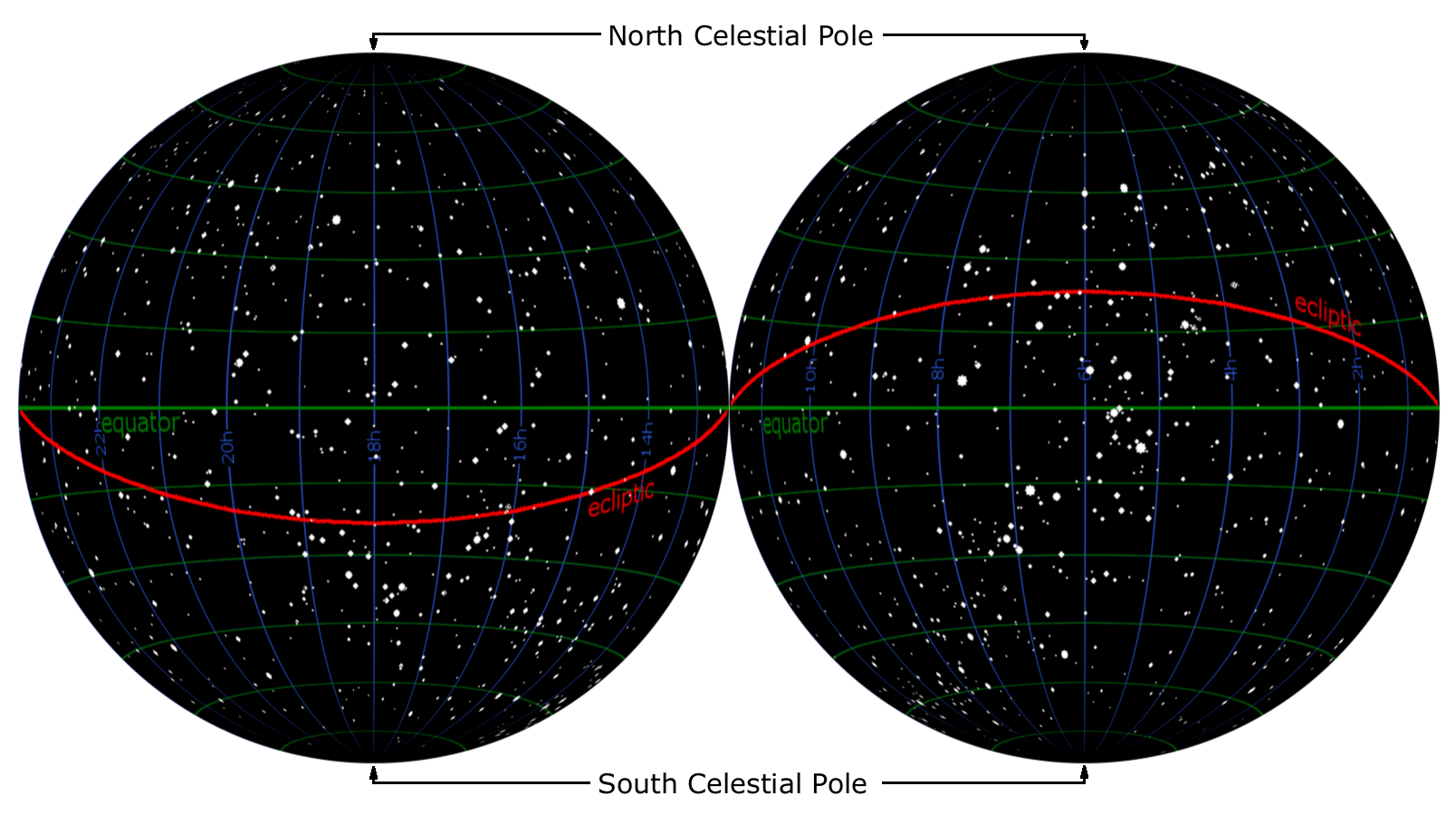
Because the Earth is tilted, the ecliptic doesn't match up with the equator except on equinoxes twice a year.

The red line is the path the Sun takes. The green line is the equator.

When it comes to measuring where stuff is in the sky, there's two axes of celestial coordinates: declination (DEC) and right ascension (RA).

Declination measures north/south in degrees: North (90°) to Equator (0°) to South (-90°).
Right ascension measures eastward from a point of origin (the vernal/spring equinox) in hours, with there being 24 hours in a full circle, due to the rotation of the Earth. This is because astronomers measure right ascension by timing when an object passes through the highest point in the sky, or the meridian. Each hour is about 15° in width.

Anything anywhere in the sky can be given a set of coordinates.

Looking at the star of Betelgeuse:  DEC +07° 24′, RA 05h 55m

This means Betelgeuse sits about seven degrees north of the equator, and on the spring equinox (21 March), it takes about five hours and fifty-five minutes before it reaches the meridian of the sky.

Let's look at the Zodiac astronomically.

Here's the actual map:


As you can see, the constellations take up different areas of real estate. Sometimes the Sun will spend as little as a few days in some constellations and several weeks in others.

Right ascension starts on the spring equinox and is also called the "First Point in Aries"... however, due to precession, the spring equinox actually lies in Pisces today!  Here's how much it's shifted over the past seven thousand years:


(A brief word about something called precession: the Earth wobbles on a long-term cycle of about 26,000 years, where her north pole points to different parts of the sky. (Polaris isn't always going to be the North Star.) Because of this, the constellations have shifted from where they were originally observed a few thousand years ago, and don't line up with the calendar we know and love today. Your astrological zodiac sign no longer corresponds with the constellation of the same name. Sorry.)

We'll start on the vernal equinox and have a look at all the Zodiac constellations.

Constellation:Coordinates:Sun enters/exits:Time in constellation:
Pisces RA: 1h DEC: 5°12 March – 18 April38 days
Aries RA: 2h DEC: 15° 19 April - 13 May25 days
Taurus RA: 4h DEC: 15° 14 May - 19 June37 days
Gemini RA: 7h DEC: 20° 20 June - 20 July31 days
Cancer RA: 9h DEC: 20° 21 July - 9 Aug20 days
Leo RA: 11h DEC: 15° 10 Aug - 15 Sept37 days
Virgo RA:13h DEC:0° 16 Sept - 30 Oct45 days
Libra RA: 15h DEC: -15° 31 Oct - 22 Nov23 days
Scorpio RA: 17h DEC: -30° 23 Nov - 29 Nov7 days
Ophiuchus RA: 17h DEC:-30° 30 Nov - 17 Dec18 days
Sagittarius RA: 19h DEC: -25° 18 Dec - 18 Jan32 days
Capricorn RA: 21h DEC: -20° 19 Jan - 15 Feb28 days
Aquarius RA: 22h DEC: -10° 16 Feb - 11 March24 days

Which is your favourite zodiac constellation?

What is your astrological zodiac sign, and what is your astronomical zodiac constellation (based on your birthday)?

___________________________________
Her Grace is fond of Scorpius, because it really does look like a scorpion.


If you wish to explore more Astrological applications of the Zodiac, check out Chris Votey's "Madness of a Modern writer" A to Z challenge where he's been combining the Greek and Chinese Zodiacs to create character profiles.  It's been fun for me, from a writer's point of view.

Saturday, 29 April 2017

Y is for Year

Happy Birthday to you, if you happen to have a birthday this year. (Sorry, Leap Year Babies. No birthday cake for you.)

Essentially, a year is the time it takes for the Earth to go around the Sun. So yes, Venus has a Venusian year (0.6a) and Mars has a Martian year (1.88a). But for the purpose of today, I'm going to talk about how the Year is a standard unit of measurement.

Astronomers need a way of measuring things. Since there's no standard galactic measuring stick for, well, everything, we've taken what's most familiar and made that our basis. For example, the mass of planets is measured by the mass of the Earth (M) and the mass of stars is measured by the mass of the Sun (M). Short distances are measured by Astronomical Units (AU), which is the mean distance from the Earth to the Sun and long distances are measured by lightyears (ly) (the distance it takes for light to travel a year).

In astronomy, one measurement of time is the Julian year (symbol: a), which is exactly 86,400 seconds (as seconds are the base unit of time in SI). This equates to about 365.25 days, if that makes your brain hurt less. That's a very familiar number, with our calendar years being 365 days, except for every four years, when we add up the .25 of a day, and tack on an extra Leap day, so our days can sync up with our years. Our current Gregorian Calendar is based off this cycle.

While we've known about this extra quarter-day for a few thousand years, we didn't realise exactly how precise we'd not calculated it, so our earlier calendars had a bit of drift going on, and occasionally needed serious correction. That's why the ten days of Oct 5-15 1582 AD (CE) don't actually exist. Also why Ramadan appears to drift in relation to our civil calendars. And if you were born in Sweden in February 30, 1712, I am very, very sorry for you. Here's three hundred years' worth of birthday cake to make up for that double-leap day.

Let's put calendars aside and talk astronomy.

Julian years are used to measure duration. For example, how long would it take light to reach us from Alpha Centauri? About 4.6 years. (A Julian year is what they use to calculate a lightyear.)

How long does it take for Jupiter to go around the Sun (aka a Jovian year)?  11.8618 (Julian) years.

There's other types of years such as the sidereal, tropical and draconic years, used to measure stuff in relation to Earth but for general astronomical purposes in measuring duration in the rest of the Universe, we prefer the Julian year. Feel free to go hardcore if you wish regarding the other year types.

______________________________
Her Grace does not mind collecting years as she goes along. Old age is a privilege denied to many.

Friday, 28 April 2017

X is for X-ray


Finally, an AtoZ blog entry where I don't have to stretch to find an entry.

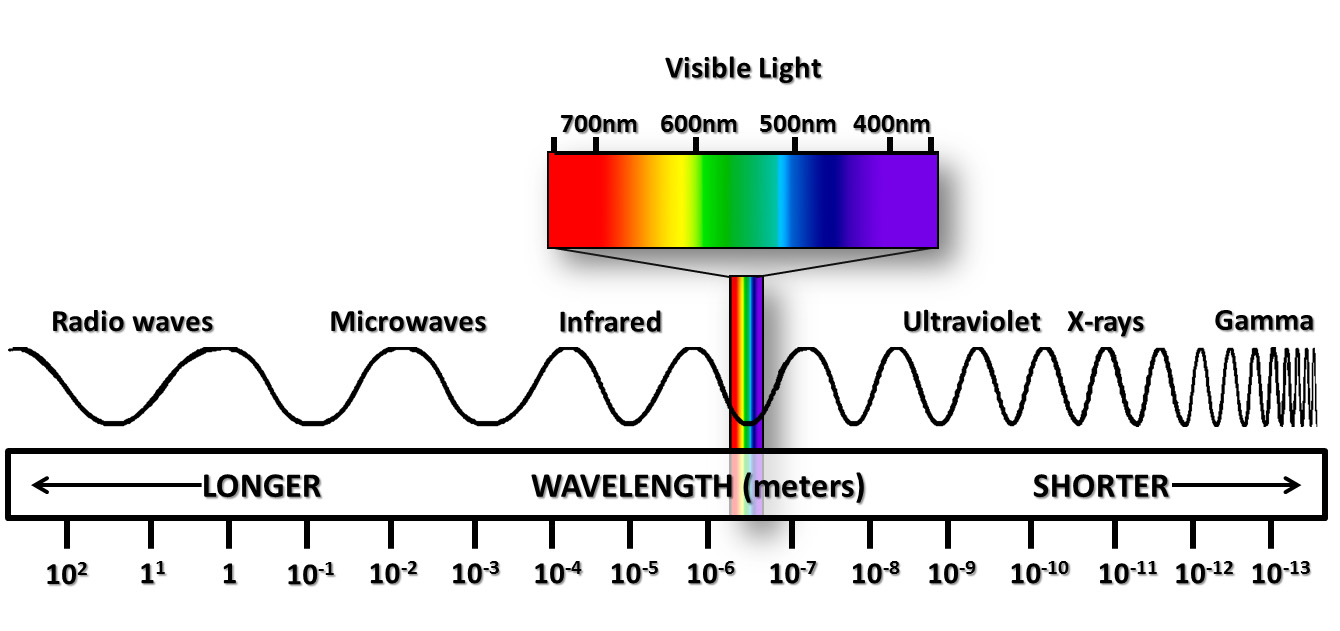
We've talked a bit about the electromagnetic spectrum during the A to Z--RadioInfrared, Visible (Optical) and Ultraviolet--because light is primarily the only tool we have to explore the universe.

While other bloggers are really pushing it to find something for the letter X, here's something that comes naturally to astronomers: X-rays

We all know about X-rays for their medical uses: broken a bone or been to the dentist, chances are you had an X-ray photograph taken.

X-rays are cool because they can penetrate certain types of matter and show us other types. This is because they're highly energetic. Naturally, this is a good thing for astronomers. We like looking at high-energy things.

X-rays were discovered in 1895 by Wilhelm Röntgen. Here's his original paper: German,  English Translation

"Hand mit ringen," Will said.
His wife said, "I have seen my death!"  Drama queen.
In fact, X-rays are often called Röntgen rays. What did Wilhelm Röntgen call them?  X-rays, with X standing for "mysterious", because he really wasn't sure what they were at first. Eventually he and a few scientists figured it out.  A few early articles about Röntgen's mysterious X-rays.

And, like any other scientist that thought science stuff was nifty, he played around with it, and even freaked his wife out by using her hand as a guinea pig by taking the first X-ray photograph.

This was fascinating, as it's really the image of an X-ray shadow, as the minerals of the bones block out the X-rays. Lead is also good for blocking out X-rays.

So, what makes X-rays so useful for astronomy?

Remember how stars come in different colours, depending on how hot they are?  If you boost the temperature of an object in outer space to waaay hot (more than a million Kelvin), its peak colour goes on beyond blue all the way up into X-rays.

This makes X-rays really useful for detecting high-energy events and objects.  Neutron stars and accreting black holes emit X-rays. Supernovae emit X-rays. (Stars emit X-rays, as they emit through the whole EM spectrum, though not to the same degree the Really Powerful Stuff, like active galactic nuclei, does.) Want to know where all the moving and shaking is happening in the universe?  Look for the bright X-ray spots.

Now, X-rays are absorbed by our atmosphere (thankfully), so any X-ray observatories need to be in orbit, like the Chandra X-Ray Observatory.

Here's some cool pictures taken in X-ray:

Looks very different from the hand mit ringen, as these are not images of the shadows of X-rays, but rather the emissions of X-rays. That's why they're so bright.

______________________________
Her Grace once calculated how much X-rays she emitted. Answer: not much.

Wednesday, 26 April 2017

V is for Visible Spectrum

Until the past century, pretty much all astronomical work took place with the observance of the visible spectrum. MK-1 Eyeball (the naked eye) was how observation took place.

The visible spectrum isn't terribly big--only 390 to 700 nm--considering just how wide the electromagnetic spectrum is. Yet within that short range, we've been able to accomplish some magnificent astronomy.

Before we discovered calorific rays (infrared) or chemical rays (ultraviolet), we were playing with the visible spectrum. Spectroscopy allowed us to divide up light into its different wavelengths and observe the universe. You can tell a lot about the composition of something by the frequency and amplitude of the light it emits.

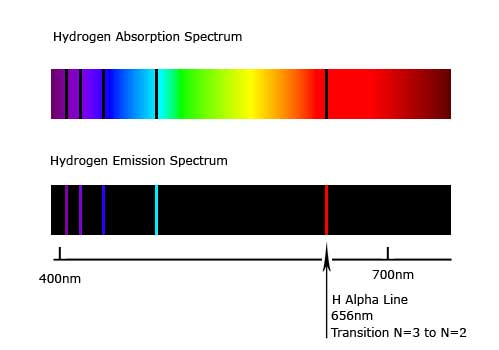
Early scientists (like Herschel), noticed that certain spectra had dark lines. These are absorption lines, when atoms (like hydrogen) absorb certain light frequency.

Johann Balmer noticed that hydrogen absorbed certain frequencies. This helped us discover just how much hydrogen was out there, and also determine the nature of the hydrogen atom itself. (Hardcore: the absorption lines happen when a hydrogen electron absorbs that photon's energy, thus causing it to jump or transition to the next electron shell.)

All elements exhibit absorption lines. While some are seen only "off-stage" (ie, in the infrared or ultrviolet or beyond, especially if red-shifted), many can be seen in the visible spectrum.

Here's the visible spectrum of the Sun. As you can see, there's plenty of dirty metals lurking within our nearest and dearest star. (Can you find sodium?  Hint: it's orange.)
http://www.extremetech.com/wp-content/uploads/2013/10/sun.jpg
Click here to embiggen.

__________________________
Her Grace is best viewed in the visible spectrum.


Tuesday, 25 April 2017

U is for Ultraviolet

Yesterday we talked about lightbuckets and the light we can capture in them. Today we'll talk about one of those frequencies, Ultraviolet.  Most people know about ultraviolet from sunscreen commercials, and good old Slip Slop Slap campaigns.

In 1800 Herschel discovered Infrared (he called them Caloric Rays because they felt warm). Like any good scientist, he wondered if something similar could be found on the violet end of the spectrum. Alas, when he set up his thermometer on beyond violet, he didn't detect any heat. Oh well, he said, and focused on what he knew.

Then in 1801 Johann Wilhelm Ritter refused to be daunted by the violet end of the spectrum. See, he'd read Herschel's paper, and thought that Herschel hadn't gone far enough in his investigations. As a chemist he was familiar with the photosensitivity of certain chemicals. He knew that silver chloride turned dark when exposed to sunlight, reacting stronger to blue light, rather than red.

When he exposed a piece of paper coated with silver chloride to a spectrum, he discovered the strongest reaction was in the “invisible” side of violet light. Because of the chemical reaction, he named this invisible band of light “deoxidizing rays” or “chemical rays”. Essentially, he was one of the first to create a "photo-graph", or a literal recording of light.

He'd discovered Ultraviolet.

But what he also discovered was ionising radiation.

The electromagnetic band is divided into two different kinds of radiation: non-ionising waves, like radio waves, and ionising radiation, like X-rays.

Ionising radiation is radiation that's strong enough to knock electrons off an atom or molecule. The ability to cause a reaction in a chemical such as silver chloride is due to ionisation. It's the scary stuff that can potentially damage DNA and cause cancer.

Fortunately, most of the harmful ionising radiation (from UV on up to gamma rays) gets filtered out by our atmosphere. Still, visible light and some near UV get through. These are the frequencies that start to chemically affect stuff. (This is also why you don't store your beer in sunlight.)

Non-ionising radiation like radio waves can pass through our atmosphere, but doesn't pose a threat to us. (FYI, the radio wavelengths that mobile phones use is safely in the radio waves range. Mobile Phones do not cause cancer. Feel free to carry them in your bra.)

Ah, so what's the benefit of the ultraviolet spectrum in astronomy? It's good for detecting hotter objects. UV is very good for detecting chemical composition, very old stars or very young stars, and for identifying star-forming regions, which denotes active galaxies.

This UV images of the Andromeda Galaxy (M31) shows it's active star-forming areas:


When the variable star Mira was imaged in UV by GALEX in 2006, scientists were amazed to discover it had a tail. Mira moves through space rather quickly for a star (130km/s), so fast, it even has a bit of bow shock in the interstellar medium (ISM) and a tail of matter streaming behind it for thirteen lightyears:


__________________________
Her Grace likes to think of UV as the "hot and bothered" frequency.

Monday, 24 April 2017

T is for Telescope

The Universe is full of light. Therefore, if we want to know more about the Universe, we need to sample some of that light for analysis. One of the best ways to capture that light is in a lightbucket called a telescope.

For thousands of years astronomers only had one method of capturing light--MK-1 Eyeball, aka the naked eye. Look up in the sky, what do you see?

Lots of stars, most of the major planets and a few other fuzzy objects were easily observable with the naked eye. It had its limitations, as it only detected wavelength between 390 to 700 nm. Also, it was limited in its resolution and the number of photons it could capture.

For a few thousand years humans knew that carving glass into certain shapes could bend light, focusing it, bringing more photons to the human eyeball. Then really recently, in the early 1600's, a few bright sparks put a couple of lenses in a tube, looked through and yelped, "Wow! I can see far! Tele-scope!" The first refracting telescope was born. Thomas Harriot thought it would be nifty to look at the sky through this thing. He was right. To him, the Moon looked awesome. He could see such detail!

Galileo and his refractor.
About the same time, Galileo built his own and looked upwards. To his amazement, he found four moons orbiting Jupiter. These details were not visible previously. The ability of the telescope to capture more photos and resolve very distant objects was totally amazing.

Newton's reflecting telescope.
Humans are lots of fun because they'll take an idea and run with it, seeing if they can improve on the original design. Another bright spark (some guy named Newton) wondered if a parabolic mirror could serve just as well for focusing the light. Sure enough, it worked wonders.

So lots of gentleman scientists played with this new tele-scope technology, improving it in size and quality, and peered into the heavens with it. At first, it was mostly planets they stared at, and various nebulae, as the stars were too far away to resolve to anything but points of light.

That didn't stop them from having fun with the light they captured. Prisms were notorious for breaking plain light up into pretty rainbows called spectra (singular: spectrum). When that happened, they then discovered things like absorption lines, infrared,  and ultraviolet.

You can go really big with radio telescopes,
like they did in Arecibo.
The infrared and ultraviolet discoveries really sparked some imagination. Could there really be "invisible" light beyond the visible spectrum? If so, could we capture it?

Sure.

With lower frequencies such as radio waves, they discovered they could be captured with antennas. Later, radio dishes (very similar in shape to the parabolic mirrors used to capture light) helped focus radio waves onto the receiving antenna, instead of just trying to pick up any old radio wave that happened to bounce by, like the aerials on our rooftops.

X-ray telescopes, same thing. A large parabolic mirror focuses X-ray wavelengths onto an X-ray detector. Problem with X-ray telescopes is that they're rather useless on Earth, as our atmosphere blocks out most stellar X-rays. So if we wanna gather X-rays, we've got to put our light buckets into orbit.
X-ray telescopes, like the Athena X-ray Observatory, can have lots of fun capturing the emissions of X-ray sources from orbit.

By the end of the 20th Century, humankind had come up with all kinds of telescopes to observe different kinds of electromagnetism. We're very good at capturing photons of all wavelengths, studying them, and thus, through sheer observation alone, we know about our Universe.

Do you have a telescope? If not, have you had a chance to look through one? If you haven't, see if you can find a local star party. Many planetariums and astronomical clubs hold them regularly. I recommend waiting a few months for Saturn to rise, for that is one spectacular planet to look at through a telescope.


_________________________
Her Grace observes through a Celestron Nexstar 130SLT 5" reflector.

Saturday, 22 April 2017

S is for Star

S is for Star, and really, you cannot talk about astronomy without mentioning stars. Impossible.

Anyone who's ever expressed the slightest interest in astronomy does so because of stars.  You look up in the sky, see the stars, and go, "Cool!" Stars are what get us interested in space.

Here's an earworm to annoy you for the rest of the day, "Twinkle Twinkle Little Star" (the astronomically correct version):


Stars are the most obvious part of the universe because they shine so brightly along all the electromagnetic spectrum. I consider them a key component of the cosmos. They are the movers and the shakers. They are responsible for all the "metals" (ie elements heavier than H and He) out there. E V E R Y T H I N G out there that's not Hydrogen/Helium, is because of stars.

As you know, hydrogen makes up a good three-quarters of the universe. When that hydrogen (usually in a nebula) gets enough gravity to collapse together, fusion starts and you get a star.


Vital Stats of Stars

Size

Stars range in weight (measured in solar masses or M) from about approximately 0.2 M  to humongous beasts pushing 150 M. Now, that might not seem like a very big range, seeing that one solar mass (M) equals the weight of our Sun at 1.98855 × 1030 kg. But if you look at the radii of these stars, the smallest is about 20% wider than Jupiter, but the biggest is a whopping 1500 times as wide as our Sun. Frickin' huge.

Here's a size comparison:


Also, the bigger a star, the faster it burns through its hydrogen. Really, really big hypergiants have been known to live for the brief moments of a few million years. Living fast, dying young, they leave a really impressive supernova/hypernova before letting its corpse collapse into a neutron star or even a black hole.

Smaller stars last a lot longer. Our own Sun will live about 10 billion years, whereas some red dwarfs could possibly live for trillions of years.

OGLE-TR-122b is the smallest main sequence star we've discovered so far that's still fusing hydrogen. If it got any smaller, it wouldn't have enough gravity to ignite fusion. Unless you're fusing, you ain't a star.

Colour

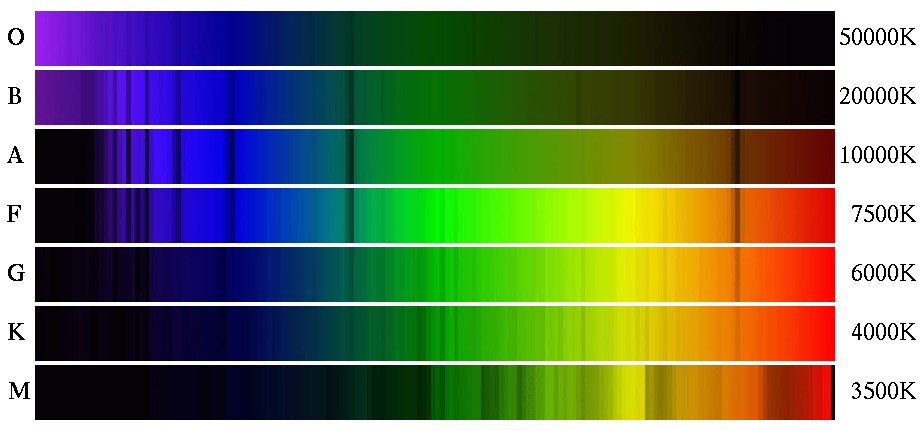
Stars range in colour, which also correlates with temperature.

Stars are classified according to colour(temperature), with blue stars being the hottest and red stars being the coolest.


O B A F G K M
The spectra of star types. See how the spectra peak in certain colour ranges? That's why stars appear coloured.

Blue O-type stars tend to be 30-40,000 Kelvin.
Blue-white B-types are 20,000 K,
White A and F stars are about 8-10,000 K
G-type stars, like our yellow Sun, are about 6000 K
Red K and M-type stars can be as cool as 3000 K  (For reference, you are around 310 K).

Look up in the night sky and see if you can tell what colour a star is? While most of them appear "white", compare nearby stars to see if you can detect a faint bluish cast or reddish cast.  Betelgeuse in Orion is distinctively red, as is Antares in Scorpio. Rigel in Orion is rather blue.

Why aren't there any green stars?

Actually, there are. Any "white" star is actually radiating in the green part of the visible (optical) spectrum. Green happens to be right in the middle of the spectrum, so when a star is emitting green, it also emits red and blue. Combine all these together (additive colours), and they look white. Our Sun, a G2-type star is generally classified as Yellow-White. But if white is really green, that makes our Sun a yellow-green star. (Consider how much green light gets reflected by plants on Earth. That light's gotta come from somewhere.)

Birth and Death of a Star


So, a star is born from the gas of a nebula. After it gets over its initial teething phase, it settles into the Main Sequence, happily fusing its hydrogen into helium. It'll spend about 90% of its life like this.

Once it runs out of hydrogen, they move off the main sequence, do a few interesting things (like helium flashes, variable pulsing, puffing up like balloons), then die.

When it comes to the death of stars, the manner of its demise depends on its mass.  For smaller mass stars, like our Sun, it'll inflate into a red giant, then with a gentle poof, shed its outer layers, leaving the cooling cinder of a white dwarf.

But if it's a massive star, especially of the live-fast-die-young category, it starts fusing everything into onion layers of elements until it reaches iron. Once that happens, fusion stop, the pressure keeping the star puffy ceases, the star collapses in on itself, rebounds, and dies most violently B A N G!! in a  spectacular supernova.


Don't let the gentle spread of this light echo fool you. This time-lapse covers a period of four years. The light echo is about six light years across. We're talking some serious velocities here.

The energy released in this explosion is enough to start a new wave of nuclear reactions that fuses iron into the higher elements like gold and uranium and blowing them out into the universe.

Whatever is left over gets fused into neutrons and collapses down into either a neutron star or a black hole in the middle of a brand new nebula.

Meanwhile, the shockwave of a supernova can extend for several parsecs, rolling through any neighbourhood nebular clouds of hydrogen, possibly triggering some of it to collapse into new stars.

And thus, the cycle begins again.

Some people just like looking up in the skies. And that's okay. Do you have any favourite stars?  What make them your favourites?  I'm fond of Betelgeuse and Canopus.

No hardcore stuff today, unless you want to investigate more about V838 Mon which occurred in 2002.

___________________________
Her Grace is sometimes content just to stare up at the stars with MK-1 eyeballs.

Friday, 21 April 2017

R is for Radio Waves

Since everything in the Universe is so terribly far away, the only way we can science it is through observation. Fortunately, we have the Electromagnetic Spectrum, which can tell us all sorts of things.


At the high end we have the powerful, ionising wavelengths of X-rays and gamma rays, and at the low end we have the more zen-like non-ionising wavelengths such as microwaves and radio waves. All these different wavelengths interact with baryonic matter in different ways. This difference gives us an advantage in astronomy. For example, Earth's atmosphere will block gamma rays but will allow radio waves through.

This makes radio waves both ideal and infernal for ground-based astronomy.

If you tune your car radio in between the official broadcasting stations and listen to the static, some of static comes from the universe. (Radio static is how they discovered the Cosmic Microwave Background, or the radio wave echo of the Big Bang.) Sounds like this:


The atmosphere isn't uniformly transparent to radio waves, because our atmosphere is a rather complex thing. Some frequencies will shoot straight through, others will bounce around. This bouncing around can cause interference, which you can detect on your car radio as static.

The closer you are to population centres, the stronger the radio will be, because we have radio broadcasters and mobile phone cell towers and all sorts of radio-bright sources.  Also, humidity in the atmosphere can block out radio waves.

So, what's an astronomer to do? The best earth-based radio astronomy sites are those away from civilisation, out where it's dry (low humidity) and "radio-quiet".  Western Australia has a Radio Quiet Zone  in the Murchison (our gratitude to the Wajarri Yamatji people, the traditional owners of this land) for the Square Kilometer Array, a large radio telescope. http://skatelescope.org/

Don't think that radio astronomy is out of reach for the amateur astronomers and citizen scientists. There are plenty of amateur radio astronomy clubs and organisations throughout the world.

But if you don't want to go hardcore and build your own radio telescope, you can still experience radio astronomy. If you tune your radio to the frequency of 1420 MHz (that's 1420 AM), you could listen to the hydrogen of the Universe speak to you. Sounds like this.

Spectral lines from other radio-sensitive stuff are detectable in radio astronomy:

  • 1400 - 1427 MHz: 21cm hydrogen line
  • 22.01 - 22.5 GHz: Water
  • 23.6 - 24.0 GHz: Ammonia
  • 36.43 - 36.5 GHz: Hydrogen cyanide and Hydroxil
  • 72.77 - 72.91 GHz: Formaldehyde

More about how radio astronomy works.

Here's some pictures of stuff in radio frequencies.

Galaxy M51 (Whirlpool Galaxy) in radio and optical:


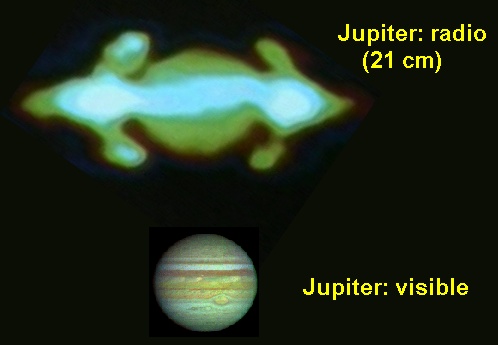
The planet Jupiter is also radio-bright:


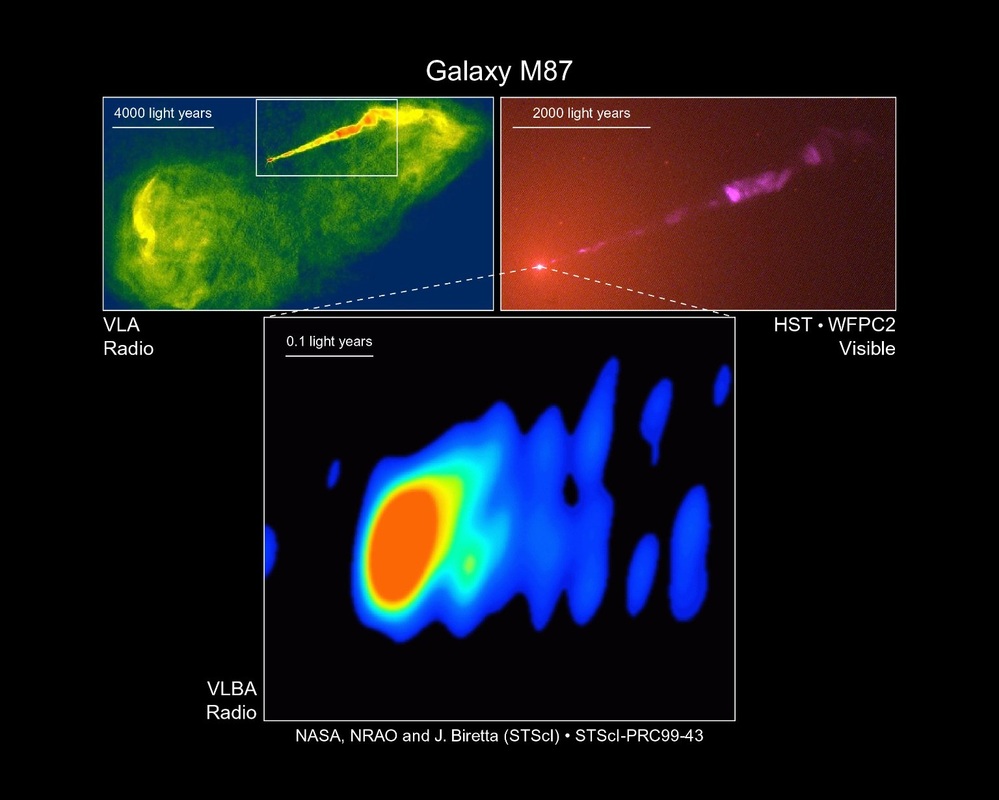
Galaxy M87 showing off a radio-bright jet from its supermassive black hole:


The Sun in optical, radio and X-ray:


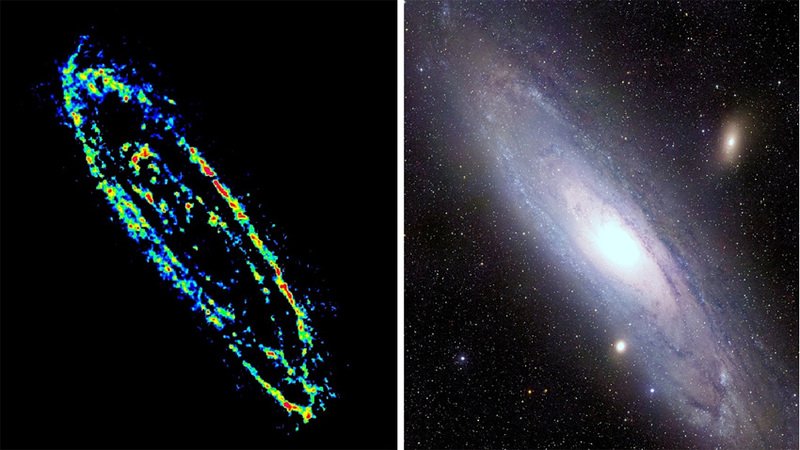
Galaxy M31 (Andromeda Galaxy) in radio and visible. Radio has a way of shining through the dust that would normally block visible light. This is one of the advantages of radio astronomy.


What the Milky Way looks like at 408 MHz:


Radio astronomy, indeed astronomy in all the wavelengths provides astronomers with a different point of view.

________________________
Her Grace once observed the universe through a mate's homemade radio telescope. It looked an awful lot like a silver umbrella attached to a laptop, because it was.

Thursday, 20 April 2017

Q is for Quasar

In the middle of the 20th Century, astronomers were astounded to find a very bright radio source--stunningly bright. In fact, they were brighter than anything else previously known  (or since, really).  They called them Quasi-stellar Objects (QSOs).

But what were they? Astronomers captured their spectra and had a look. The spectra looked really odd, until they figured out that they were extremely redshifted. Redshift is a nifty astronomy tool. Here's how it works:

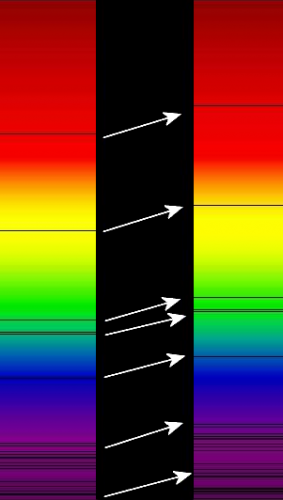
Original spectrum    vs   a redshifted spectrum
See the absorption lines in the rainbow spectrum on the left? This is a normal spectrum where some of the light has been absorbed by an element (say, hydrogen and its Balmer Lines).  When the light that makes this spectrum comes from very far away, the expansion of the universe stretches it out and makes the frequency drop. The result is the spectrum on the right, where the absorption lines move in a red-ward direction. This is redshift. Think Doppler Effect.

The greater the redshift, the farther away an object is. The spectrum sampled from quasars were so redshifted it took us a while to figure out just how redshifted they were.

In other words, these really bright radio sources were really, really far away. That was doubly-amazing because of the Inverse Square Law--intensity reduces with distance.

"Dude!" we cried.  What could possibly create so much energy to be so bright from so far away?

Eventually, we figured out quasars were really, really active distant galaxies and that the extreme energy output came from the accretion disks of the  supermassive black holes in the middle of those galaxies. Those suckers can really put on a shine when actively consuming some poor star.

(Is our own Milky Way a quasar? Currently no, as our Sagittarius A* is a rather quiet supermassive black hole at the moment.) Quasars are believed to be an early universe phenomenon because we observe them as coming from waaay back in time. But that doesn't mean that Sgr A* couldn't become a quasar in the future, given enough to eat.

So we figured out that quasars are:
  • really old
  • really distant
  • really bright
Once we established that, we realised they could be used as a kind of anchor point in mapping of the skies. See, the farther away something is, the less likely it is to apparently move.

Want to know more about quasars?

__________________________________
Her Grace prefers to study objects that are a little bit closer than z=7.085.

Wednesday, 19 April 2017

P is for Planet (It's okay, you can call Pluto a planet if you want)

In ancient times, skywatchers noticed certain stars wandered about, and didn't stay fixed like the rest of them. The ancient Greeks called them  πλανῆται (planētai, "wanderers"), and the name stuck. Indeed, if you observe them for several days or weeks, you can notice them inching along relative to the stars in their apparent proximity.

Essentially, a planet orbits a star. All other descriptions are mere refinement.

In 2006 the International Astronomical Union (IAU) issued an updated definition of what a planet is. This came along because more planets had been discovered on beyond Pluto. Once they realised they'd have dozens, potentially hundreds of new planets, they thought they'd come up with some definitions to help sort or categorise the planets. This definition is based off the gravitational interaction of a planet with its environment:

"A planet is a celestial body that:
  1. is in orbit around the Sun, 
  2. has sufficient mass for its self-gravity to overcome rigid body forces so that it assumes a hydrostatic equilibrium (nearly round) shape, and 
  3. has cleared the neighbourhood around its orbit."
Based on this, we've got four Terrestrial planets (Mercury, Venus, Earth, Mars) and four Gas Giants (Jupiter, Saturn, Uranus, Neptune).

"But what about Pluto?" you cry! "They demoted it! It's no longer a planet!"

Uh, yes but no. Pluto is still a planet. Go ahead and call it one if you want. It's new classification may be "dwarf planet", but that is still a planet.

Shot this pic of Venus a month ago
with my smartphone thru my telescope.
When I was a wee junior astronomer, I always thought Ceres got a bad rap. It was classified as a planet when discovered in 1801 (yep, it was discovered before Neptune).  Everyone thought this was nifty, until lots of gentleman scientists started discovering more and more rocks. "Surely these cannot all be planets," they mused. Once they figured out just how small and numerous these rocks were, they reclassified them as "asteroids" in the 1850's, and poor Ceres got demoted.  Yeah. These things happen when you start looking and finding stuff.

So, when the 2006 definition came along, Ceres got re-promoted and classified as a planet once more, albeit in the "dwarf planet" category. I didn't mind (Okay, I was ecstatic!). But many people who weren't around for the 1850 demotion of Ceres, didn't realise the historical precedence for this sort of card-shuffling of our Solar System.

Just like in the 1850's, the 2006's brought a new definition of a classification, because lots more of whatever it was they were classifying were found.  Kuiper Belt Objects (KBOs) were being discovered all the time, and some of them were large enough they could be classified as planets. Also, planets were being discovered around other stars. Everyone went, "That's so cool!" Astronomers went, "Yeah, but we need to sort our rocks."

So the definition was born.

A dwarf planet's not just about size. The only change between the classification of a dwarf planet and a terrestrial planet is that a dwarf planet hasn't cleared the neighbourhood around its orbit. So, Ceres wanders along in the Asteroid Belt and Pluto and Eris and Sedna and company wander about in the Kuiper Belt.  (Trojans don't count, because they're gravitationally shepherded.)

Our Moon, as shot by Your Truly.
Refinement #1:  If an object meets the above criteria, but doesn't clear it's orbit, it's a dwarf planet.

I notice you didn't ask about the Moon (any of them). Couldn't the 2006 planet definition qualify them as well?

Enter Refinement #2: If an object is in orbit around another object, it's a satellite (aka a moon).

Just thought I'd mention this, as we have moons (like Ganymede) that are bigger than Mercury and Pluto. But, as Ganymede and her sisters are in orbit around Jupiter, our Luna (Moon) is in orbit around Earth, and Titan and his mates are in orbit around Saturn, we're calling them satellites.

So, what about rocks that aren't round and aren't orbiting anything else?  We call them Small Solar System Bodies (SSSBs).  These include asteroids, comets, pebbles and anything else with a gravitational connection to the Sun.

So go outside tonight and look up. Can you spot any planets?

Want to know if that bright light up in the sky is a planet or a star? Easy; stars twinkle. Planets don't. (If the light blinks regularly and is moving, it's a plane. If it grows bright then fades and is moving, it's a satellite. If it flares up really bright, enough that you could see it during the day, and lasts several weeks before fading, it's a supernova. If it's fuzzy and grows a tail, it's a naked-eye comet. If it's sudden, really really bright, and takes up your whole field of vision, it's the flashlight of a police officer who's wondering why you're laying on the ground staring up at the sky.)

So, want to know what planets are currently up?  Why, all of them, if you know where and when to look.

The early evening sky favours us with a glimpse of Mercury in Pisces. Uranus is also close by, but twilight might be too bright at the moment to spot it well. (Give it a go in about six months' time. Under the right conditions, Uranus can be spotted with the naked eye and some skill in very dark skies. But if you've got binoculars or a telescope, I recommend this for better luck.)  Mars isn't too far behind in Aries.

My wee shot of Saturn.
A couple of hours after sunset should give you bright Jupiter in Virgo, rising in the east. While easily the brightest planet in the sky right now, you'll really have a show with binocs or a telescope, because you'll be able to spot the four Galilean moons and maybe even see banding.

You'll have to stay up late, or get up early to see Saturn between Scorpio and Sagittarius. This year and next year is excellent to view Saturn through a telescope, as the rings are pretty much as full on tilted our way as they get.

Neptune is a morning star in Aquarius and Venus is close by, just before dawn.

__________________________________
Her Grace loves to stare up at the sky, and does so nearly every single night.

Tuesday, 18 April 2017

O is for Orion


Orion has got to be my favouritest constellation. It's so big and obvious and has so many nifty features that makes it ideal for introducing people to astronomy.

Orion sits right over our equator so it's visible to most of the Earth, making it accessible to pretty much every human. Even if you're at the North Pole or in Antarctica, you will still be able to partially view Orion.

Honestly, I don't know where to begin in sharing the awesomeness of this constellation. I'll touch on a few things, but leave the rest of the exploration of this fabulous constellation to you. Right now Orion will be sitting low in the western sky, just after sunset.

On a planisphere, it looks like this:


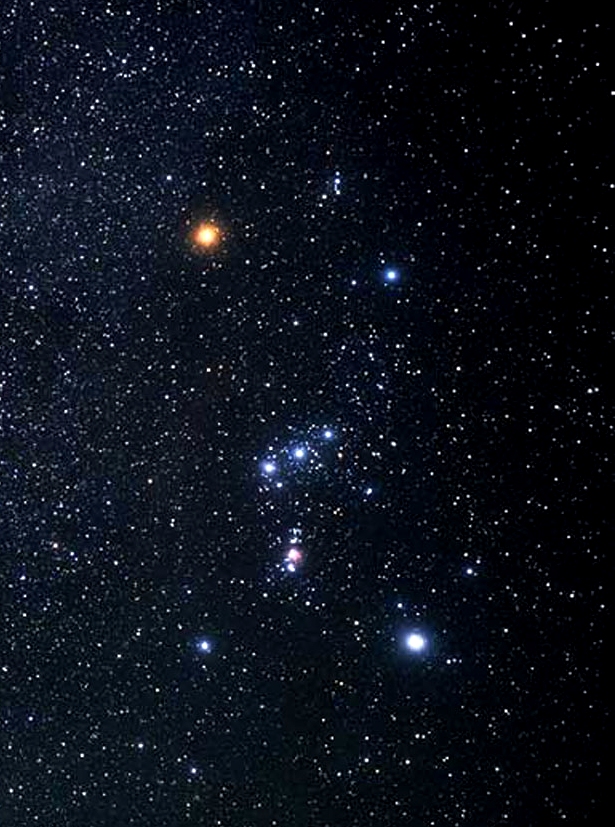
In the sky it looks like this:


Best viewing time: January, when it's high in the sky, but not too late at night.

The major stars are called:

  • Betelgeuse (obviously red)
  • Rigel (obviously blue)
  • Bellatrix
  • Mintaka
  • Alnilam
  • Alnitak
  • Saiph

The Orionid Meteor Shower in October is thanks to Halley's Comet.

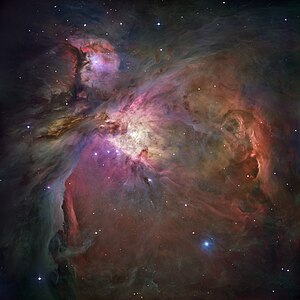
There are lots of nebulae in Orion (known collectively as the Orion Molecular Cloud Complex), but the Orion Nebula can be seen with the naked eye. It forms the sword hanging from Orion's Belt.


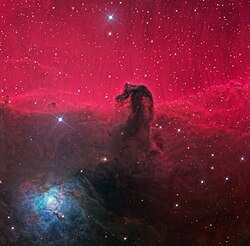
The Horsehead Nebula is a dark nebula, like we talked about yesterday. Use your telescope to see this one.


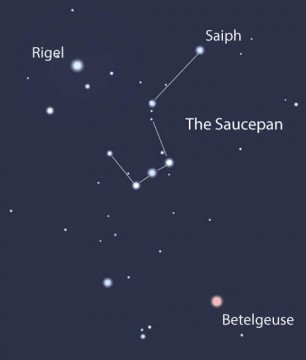
Because Orion comes in upside down in Australia, the belt and sword become an asterism called The Saucepan or The Pot:


I love Orion. What's your favourite constellation and why?

___________________________________
Her Grace will also observe Orion in July, when it reappears in the sky in the early-morning before dawn.