Showing posts with label research. Show all posts

Wednesday, 7 August 2019

Go Hard-Core with Science!

By the time you read this, I'll be at the Romance Writers of Australia Conference 2019 in frigid Melbourne, AU. For the past month or so I have been so focused on getting my writing career together for this, that I haven't had any chance to science at all. AT ALL.

So, while I'm off being an author, you can get your science on.

Science is this beautiful, wonderful pursuit by the human race as they explore their world and the universe, from the smallest known particle to the largest mega-structure their marvelous minds can conceive.

Because you are a human being, do not be afraid to go hard-core when it comes to science. You don't need a fancy degree or even a knowledge of the vocabulary to dip in your toe.

But you must dip in your toe. Follow it with your foot, and then plunge right in. Do not make the mistake that oh-so-many online denizens do of learning one little factlet from some meme someone posted to their Facebook timeline and running with it, never more choosing to research deeper. That's just irresponsible and leads to issues like Flat Earthers, Anti-Vaxxers and the "Mobile Phones Cause Cancer" crowd.

There's a lot of hard-working, dedicated scientists out there who are doing the hard research. When they do, they publish their results so everyone can have access to them and see what their work is on.

And yes, you can read these papers as well (or their abstracts at least).  Abstracts are free. Sometimes the papers are behind paywalls. Sometimes they're free-and-easy access on arXiv.org.

DO NOT BE AFRAID TO LOOK AT THESE PAPERS! Do not think that they are limited to just scientists. You can read them too. If you come across a word you are unfamiliar with, the Dictionary is your friend. Consider it leveling up by learning new vocabulary. It's not that scientists are being deliberately obtuse; quite the opposite--they are aiming for precision. English is one of those beautiful languages with hundreds of thousands of words (okay, most of them obscure) that precisely define something. When a scientist chooses a particular word, it defines and constrains the  meaning to an exact definition.

So, how do you find these papers?  For astronomers and astrophysicists, we use a database called...

The SAO/NASA Astrophysics Data System


Say you wanted to see what's been published regarding Water on Mars in the past few years?

I put in a range of dates from 2016 up to next month. My keywords were "water on Mars".  I hit the search button.

These were my results. It pulled up 1,605 papers that had anything to do with water and Mars. Now, some of the titles make even my eyes glaze over, but I trawled through until I found something interesting.


Hmm, which one to choose?  Best way is to read the abstract.

An abstract is kind of like a back-cover blurb that gives away the ending of the story. Most useful if you're trawling through looking for a paper about a particular topic.

After reading both abstracts, I chose to have a closer look at Follow the Oxygen.

Here's the abstract: 
Aerobic respiration—the reduction of molecular oxygen (O2) coupled to the oxidation of reduced compounds such as organic carbon, ferrous iron, reduced sulfur compounds, or molecular hydrogen while conserving energy to drive cellular processes—is the most widespread and bioenergetically favorable metabolism on Earth today. Aerobic respiration is essential for the development of complex multicellular life; thus the presence of abundant O2 is an important metric for planetary habitability. O2 on Earth is supplied by oxygenic photosynthesis, but it is becoming more widely understood that abiotic processes may supply meaningful amounts of O2on other worlds. The modern atmosphere and rock record of Mars suggest a history of relatively high O2 as a result of photochemical processes, potentially overlapping with the range of O2concentrations used by biology. Europa may have accumulated high O2 concentrations in its subsurface ocean due to the radiolysis of water ice at its surface. Recent modeling efforts suggest that coexisting water and O2 may be common on exoplanets, with confirmation from measurements of exoplanet atmospheres potentially coming soon. In all these cases, O2accumulates through abiotic processes—independent of water-oxidizing photosynthesis. We hypothesize that abiogenic O2 may enhance the habitability of some planetary environments, allowing highly energetic aerobic respiration and potentially even the development of complex multicellular life which depends on it, without the need to first evolve oxygenic photosynthesis. This hypothesis is testable with further exploration and life-detection efforts on O2-rich worlds such as Mars and Europa, and comparison to O2-poor worlds such as Enceladus. This hypothesis further suggests a new dimension to planetary habitability: "Follow the Oxygen," in which environments with opportunities for energy-rich metabolisms such as aerobic respiration are preferentially targeted for investigation and life detection.

Oh-kay... lots of big scary words if you're not an astrobiologist. But once you look them up, you'll see that Lewis, Vlada, Kevin and Woodward were being rather precise when they wrote the abstract.

Let's take bits of this apart and see what it really means:

"Aerobic Respiration..." - essentially, breathing oxygen, specifically, life forms breathing oxygen. While they gave a very detailed definition (and they had their reasons for it), essentially, the whole sentence is about how breathing oxygen is the preferred method of using oxygen in our metabolisms here on Earth.

"Aerobic respiration is essential..."  Advanced lifeforms like us and the cats in our laps need to breathe oxygen. Lots of oxygen on our planet means lots of life.  

"O2 on Earth is supplied by..."  photosynthesis. We all know that from Third Grade science. Plants make the oxygen we breathe.

But what if we could manufacture oxygen a different way? Do we need plants? Do we even need life, or can we source plentiful oxygen from a non-living method--an abiotic one that doesn't require a life's metabolism?  "...that abiotic processes may supply meaningful amounts of O2 on other worlds."  

The big question is, which came first? Oxygen or photosynthesis? If there's plenty of oxygen on another world produced abiotically (by a method not dependent on life, like a tree), could it be that this is what could allow multi-cellular life (like amoebae and rats and elephants) to be developed on other worlds? This is what the authors are thinking.

Until recently, space exploration has been dancing to the tune of "Follow the Water". Maybe it should be "Follow the Oxygen".

"This hypothesis is testable..." is music to every scientist's ears. Everyone loves a good idea, especially if it can be proven or disproven. Someone came up with an idea, and a way of proving it (or disproving). This is what makes science so groovy.  [end abstract]

Reference
Ward LM, Stamenković V, Hand K, Fischer WW (2019) Astrobiology, 19, 6   (Yeah, that's ApJ referencing style.)

Now, if only the article wasn't behind a paywall (or you are a university student whose library has e-subscriptions to Astrobiology magazine (Vol. 19, No. 6 is the issue this appears in). Maybe I should have gone for "Paleo-Rock-Hosted Life on Earth and the Search on Mars: a Review and Strategy for Exploration" instead. Here's a link to the full article. It's about rock-eating life bigger than a single cell. It happened on Earth a long time ago. Maybe it's also happened on Mars. "These findings suggest that rock-hosted life would have been both more likely to emerge and be preserved in a martian context," the authors say.


Monday, 10 March 2014

Going for a Trot

My current Work-In-Progress (WIP) is a Regency Romance.  So naturally, there are a few horses about, especially as my characters do a bit of travelling.
Going for a trot is much better than having the trots.

So, how long did it take our travellers to go from one place to another via horseback or carriage?  Many factors come into play: the condition of the roads, the condition of the horse, the pace or gait of the horse, the distance, the weight pulled, etc.

If an experienced rider is on the back of a conditioned horse, going at a sustainable trot, he could make about twelve-sixteen kilometers in an hour.  My Hero needs to go a distance of about twenty kilometers one morning. A trip that would take just under two hours (factoring in increasing fatigue for both horse and rider which will slow the pace somewhat towards the end).

Coming back, he rides in a carriage drawn by two horses with a few other passengers. The average speed of a horse-drawn carriage is about 8-10 kilometers an hour.  That same distance would be a good three-and-a-half hours thereabouts, depending on road conditions and other factors, like toilet breaks for the passengers.

In the 21st Century, with our highly-engineered cars, our paved highways and other conveniences, sometimes we forget just how difficult travel used to be.  Today, that same distance my hero traveled two hundred years ago would take only 33 minutes "at current traffic rates" (midnight in London), if Google Maps is to be believed.  Also, his backside would be in much nicer condition, having reclined on some nice, heated leather seats, as opposed to being punished on the saddle of a trotting horse.

Have you traveled a great distance via horse or horse'n'carriage?

___________________
Her Grace does not miss the days of inconvenient travel. That said, there is not much more comfort squeezing into the teeny-tiny seats of a budget airline.


Friday, 7 March 2014

Randomosity for the middle of Bunuru

I found this stuff fascinating this week:

Not everyone believes in four Seasons a year.  The Noongar believe in six. After having lived on their land for fifteen-plus years, I completely agree with them.  North American Season marking does not apply in Australia.  Even so, we change our Seasons at the beginning of the month, not on the solstices/equinoces.
So yeah. It's gonna be hot for a little while longer during Second Summer.

That corset is giving him
tremendous lift.
Hercules was a cross-dresser?  Yep, sure was. For some reason, this delicious tidbit of info doesn't get mentioned too often in school.

The Granite Youth Symphony plays some lovely music for you.  Can you believe they're all under the age of 18?

Throughout history, Lefties have gotten a bad rap.  But there may be advantages to being left-handed.

_______________
Her Grace comes from a family with a high proportion of southpaws and ambidexters.

Friday, 17 January 2014

What's her name?

When it comes to naming character, I'm terrible.  I could tell you all sorts of things about my characters.  I could even tell you all about their great-grandparents. But ask me their name?  I'll draw a blank.

So, I've got a few tools I rely on to name my characters:

Names with Meaning.  I love raiding foreign languages for translated words that match a characteristic of a character.  I've got to put some thought into it, however, because some translations are painfully obvious; calling a character Estupido leaves nothing to the imagination. Lord Malheur is somewhat of an improvement.  How about Mor-Lath?

Some useful tools:   Babelfish, Google Translate and Bing Translator.

Historically Accurate Names.  When I write Regency Romance or Alternate History, I strive to make my names common to the period. Having a name that is uncharacteristic of the period makes it difficult for readers to suspend their disbelief. Even going for a very untraditional spelling can shake the illusion you're trying to create.

Where to find what names were popular when: Baby Name Wizard Voyager, but be careful or you might be drawn in to the Research Trap.

Addendum:  If writing about a specific geographic area, try to stick with names that fit that geographical area.  Don't stick a Juan in Russia or a Matai in England, unless you've got a really, really plausible reason for it.  Until the end of the 20th Century, geography really mattered.

Oh, look! Popular Baby Names in New South Wales.

Anecdote:  I had a character in a village once. She had a rather unusual name that didn't fit with anyone else's; a couple of characters remarked on it. Turns out, her father was from somewhere else, and this was a family name he'd brought with him.

Borrow a Name.  If a character of mine reminds me of someone, I have no shame in borrowing their name (or a close approximation).  So if you see a character featuring your name, be flattered. Unless, of course I don't like you.  Then woe betide your pathetic, doomed character.  I've even changed characters names because I met someone unpleasant who shared a name with them.

Where to find such names?  Your old high school yearbook, your Outlook Address Book at work or your Facebook page.

Throw a Dart.  AKA "I Feel Lucky" aka googling words associated with the idea of my story and take the first name that shows up in the list.  It's random, but it works, if a character's name doesn't have to be anything special.

Baby Name Books.  What writer hasn't perused their pages?  Many a writer has a copy of baby names on their research shelf next to a Rhyming Dictionary, "The Artist's Way" and "On Writing".

www.babynames.com  Obviously.
-------
Sometimes it's important to me to have a character name right away, or a name will suggest itself. Other times, nothing's striking my fancy.  I'm not above naming a character SSS or MMM as a placeholder until I can come up with a better name.

Sometimes these placeholders morph into the character's name.  I have a King Wasson.  He's the Son of Wacifice.  And Wacifice got his name from What's His Face. Yeah. Real imaginative.

____________________
On the whole, Her Grace considers names important.  After all, she did spend many formative years being called 'Emily', and once comforted a young girl who was sick of being called 'Twin'. Stories behind names are interesting. If a family naming tradition holds true, she looks forward to having a grandson named Basil.

Wednesday, 15 January 2014

My Research Fun (or how to get infected)

I recently finished a short story featuring Gene Therapy applications. Your eyes might glaze over, but I found it fascinating!

For the purpose of my story, essentially, transgenes are inserted into cells via viruses for a beneficial purpose.

I love research.  I learn so many interesting things.  Enthralling. Engrossing. Mesmerising. Sometimes I get carried away, and find out I've spent hours and hours on all sorts of things.  It's a habit I wonder if I should curb or encourage.  Not sure.

Anyhow, back to introducing new DNA/RNA into cells via viruses.  If you were brave enough to click through to the Wikipedia article, you'd have discovered that all sorts of little issues prevent gene therapy from being a Really Useful Technology.  That's a shame. It's a fascinating concept.

It's a good thing I was writing a science fiction story. (Yeah, I write sci-fi too.)

Sci-fi is fun in that you can take some plausible science idea and "tweak" it a bit.  In real life, gene therapy isn't a wide-spread technology, but in my story it is.  Suspend your disbelief and play along at home.  This is why we call it science fiction and not science fact.  You want fact?  Go read Scientific American.  It's cool and is a hotbed for skiffy ideas.

In science fiction the science doesn't have to be exact, but it does have to be plausible. If, to 90% of the readers the science appears to work, they’ll suspend their disbelief and go with the flow.

Stories are about conflict.  Sci-fi takes an idea or a situation and posits, "What if?"

I had some conflict in that a certain number of cells required certain genes to make up for a default.  The best way to introduce those gene was by transduction with a virus. (Transfection, which is a cooler word, is the introduction of genes by a non-viral method. How disappointing. Not as sexy.)

Now, where'd the virus come from, and how do we prevent the body from wiping it out, as bodies are very good at doing?  Thus, an interesting quandary for the story.

The actual conflict comes between two biohacker sisters who are competing to get the best delivery method to save their dying mother.  Could I have written any old story about two competing sisters with a dying mother?  Sure.  But the fact that the potential to save her lies within their grasp adds just that extra bit more of emotional angst.

I also had a few other skiffy elements in the story, namely insurance company-mandated Humour Therapy and a Blues Club (complete with jazz) available by Rx only.

___________
Her Grace is fond of science, especially Biology and most especially Astronomy. How could she not write sci-fi?  Wanna engage her interest? Talk to her about stars and other heavenly bodies. She'll accept the demotion of Pluto, only because it means the re-promotion of Ceres.  If only Rosalind Franklin was given the same love.


Monday, 16 December 2013

Playing Whist

In my NaNovel, my characters play a game of Whist. Gaming is important to the plot of this novel, so I couldn't just make a reference, "And so they sat down to a game of Whist."  I had to describe a game in detail.  (Hope I wasn't too tedious. It fascinated me.)

Games and gambling were rife in the Regency era.  Even an innocuous game of Whist could be played for "penny points".  (And there goes all your pin money for the month.)

I've played Bridge (aka Contract Bridge) for many years (well, me and Dave my Bridge Partner. We once came Fifth Place in a state tournament).  But Whist?  I had the vague idea of how it worked.  And that was it.

Cue the Google Fu:
How
To
Play
Whist

I learned enough to be confident to write about the game.

Then the Dashing Duchesses post the Whipster's Guide to Whist.  How timely is that?

Similarities between Whist and Contract Bridge:

  • Trick-based play (ie one person leads a card, everyone follows suit. Highest card wins the trick).
  • Tricks played in teams (ie if you're sitting West, your partner is East. Any tricks either one of you takes counts towards your team total).
  • Trumps will beat whatever suit is led.

Whist and Contract Bridge have their differences:

WhistBridge
always has a trump suitcan be played No Trump
trump is determined by last card drawnbidding determines the trump
whoever wins more than six tricks ("book"), wins the gamebidders state how many tricks over the "book" they can take. If they can't make contract, they lose.
for every trick taken over the "book", score one pointThe higher the contract, the higher the possible points. This can range from 20pts up to over 1500pts per hand!

Compared to Contract Bridge, Whist is a simple game.  But it's so much fun!  It's a great way to learn Trick-based games.  So if you've tried Bridge and it freaks you out, consider giving a few hands of Whist a try.

_________________________
Her Grace loves a good game of cards.  She tried teaching a few people to play Bridge, but they found it a bit hard to wrap their heads around.  Maybe they could try Whist.

Wednesday, 4 September 2013

Get a Hobby

By Enoch Lau (Own work (photo)) [GFDL (http://www.gnu.org/copyleft/fdl.html), CC-BY-SA-3.0 (http://creativecommons.org/licenses/by-sa/3.0/) or CC-BY-SA-2.5-2.0-1.0 (http://creativecommons.org/licenses/by-sa/2.5-2.0-1.0)], via Wikimedia Commons
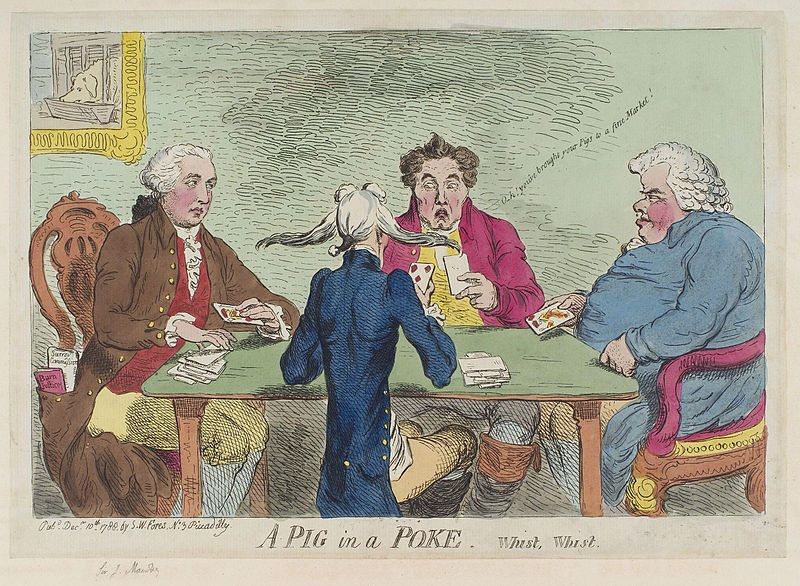
Game of cards, anyone?
Enoch Lau might play with me.
Writers need hobbies. They really do. While it can be tempting to spend all your free time on the novel, a writer really needs to nurture other interests. It’s good for the soul to have a few interests. Gets the brain working in different ways. It’s like stretching the ol’ mental muscles.

You are a better writer when you have other interests that engage your heart. Working at a day job you dislike, or housecleaning you detest, or watching TV as your only other interest, will not work. It’s important to find something you like, preferably nothing to do with writing. Stuff I do:
  • reading outside my interest (non-fiction, different fiction genres, etc).
  • Exercise. There is a strong correlation between exercise and mental function. Don’t believe me? Try it for a week.
  • Play piano.
  • Do volunteer work.
  • Play games.
  • Other stuff.
If you’re working the Day Job by day, and writing at night, and that’s your whole life, you really need to get out and get some hobbies. Don’t worry that an interest or two will cut into your writing time. Believe me, it’ll help make what writing time you’ve got higher-quality time.

 Far too busy to take on a hobby? Sit down and analyse your week. To a time audit to find out what you’re spending your time on. Consider whether all the little things you are doing are Important. Don’t confuse Urgent with Important. (You may wish to learn more about an Importance/Urgency matrix.)

 Ditch all the stuff that’s not Important. Really, you don’t need it. Your novel needs you more, and your Craft needs you to spend some time outside it on worthy projects.

Monday, 26 August 2013

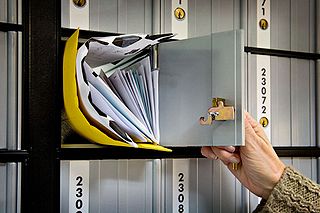
Postbox in Schenectady

By United States Postal Service (Wikipedia:Contact us/Photo submission) [CC-BY-SA-3.0 (http://creativecommons.org/licenses/by-sa/3.0)], via Wikimedia Commons
One would like to think these are contracts, not returned mss.
Sometimes I actively go looking for story ideas.   When I do, I do not latch on to the first thing that pops into my head.  Nor the second, or even the third.

When I brainstorm, I’ll write down all ideas as they come to me.  Then I ditch the first handful that came in. (Stop pulling out your hair!  Ideas are dime-a-dozen.  You can have my discards if it bothers you so much.)

Why on earth would I do that? 

Because those first few ideas were the most obvious.   I don’t wanna write the obvious.  I want to explore the obscure, the hidden, the new.  Road less traveled. Forgotten country. 

Essentially, I wanna make people consider something they might not have thought of before.  If I choose to write a fairy-tale retelling, you can bet your sweet britches I will steer far clear of Cinderella and Beauty and the Beast.   Overtold, overdone.   Go find something better.

A good writer should have some mad research skillz.  Go off and find something obscure.  Obscurity will not mean the story will be any less fascinating. In fact you may find it far more interesting, because you won’t have to compete against all the other writers’ interpretations.  Nothing sucks worse than discovering someone has already done your brilliant idea, and did it better.
____________________________
By day, Her Grace beats her head against an office cubicle wall.  By night she pinches ideas from the pockets of unsuspecting muses and discards them at random.  Occasionally they make it into stories or Relief Society lessons.